

News & Updates
Bookkeeping vs Accounting: Key Differences and Their Impact on Business Growth
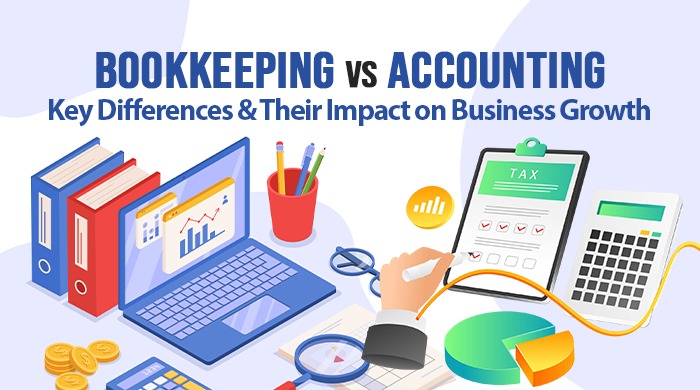
Every business needs bookkeeping and accounting procedure to prepare financial records at the end of each year/quarter. Furthermore, bookkeeping and accounting assist businesses assess their worth and make future decision
Often, bookkeeping and accounting are used interchangeably. Although bookkeeping and accounting are inextricably linked, there is a fine line between the two. Accounting encompasses more than just bookkeeping.
Emblaze provides professional bookkeeping services in Kochi, Kerala, and Chennai, helping businesses maintain accurate and well-organized financial records. The services include day-to-day transaction recording, accounts payable and receivable management, bank reconciliation, and financial reporting. With a focus on accuracy, compliance, and confidentiality, Emblaze supports startups, SMEs, and growing enterprises by simplifying financial processes, reducing errors, and enabling better financial decision-making with timely, reliable insights.
Bookkeeping
Bookkeeping is the process of maintaining and recording all financial transactions in the original books of entry of a business. The bookkeeping process involves summarising and organising all the company’s financial transactions chronologically in a systematic manner.
Bookkeeping focuses on the day-to-day financial activities and transactions of a business. The bookkeepers maintain and record the books of accounts. All the financial transactions such as payment of taxes, sales revenue, loans, interest income, payroll and other operational expenses, investments, etc., are recorded in the original books of accounts.
The books of account need to be up-to-date as it is the basis for accounting. The accuracy of bookkeeping determines the accuracy of the accounting process followed by a business.
Accounting
Accounting is the process of interpreting, analysing, summarising and reporting the financial transactions of a business. The financial statements prepared in accounting are a precise summary of financial transactions over an accounting period. These statements summarise a company’s financial position, operations, and cash flows.
Accounting consolidates financial information to make it understandable and clear for all stakeholders. It helps businesses to maintain timely and accurate records of their finances. The accountant maintains and compiles the records of a company’s daily transactions into financial statements such as the income statement, statement of cash flows and balance sheet. The financial statements help to assess the performance of a company by all stakeholders.
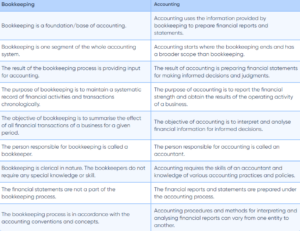
Differences between Bookkeeping and Accounting
We also provide accounting services in Kochi, Kerala, offering reliable support for businesses of all sizes. Our services include bookkeeping, GST filing, payroll management, financial reporting, and statutory compliance. With a focus on accuracy and timely delivery, we help organizations streamline financial operations, maintain transparent records, and make informed business decisions while ensuring adherence to all applicable accounting and tax regulations.
FAQs
What is the main difference between bookkeeping and accounting?
Bookkeeping focuses on recording daily financial transactions, while accounting involves analyzing, summarizing, and interpreting those records to prepare financial statements and support decision-making.
Is bookkeeping a part of accounting?
Yes, bookkeeping is the foundation of accounting. Accurate bookkeeping ensures reliable accounting reports and financial analysis.
Why is bookkeeping important for a business?
Bookkeeping helps maintain organized financial records, track income and expenses, ensure compliance, and provide accurate data for accounting and audits.
How does accounting help business growth?
Accounting provides financial insights, performance evaluation, budgeting support, and strategic planning, helping businesses make informed decisions and grow sustainably.
Related Blog
-
 GST and its Impact on Indian Economy
The GST is a Value added Tax (VAT) which is a comp...
Read more -
 Stock Audit and its Advantages
What is Stock Audit It is the physical verifica...
Read more -
 Start Up With Us Campaign
START UP WITH US CAMPAIGN is a one stop solution o...
Read more -
 Benefits of Outsourcing Your Accounts in India
Many business owners are discovering that outsourc...
Read more -
 Reasons Why Bookkeeping is Important for Your Business Growth
All corporate documents should be preserved and ma...
Read more
Catgories
-
Accounting
-
Accounts Outsourcing Services
-
Bookkeeping Services in Kochi
-
Business Accounting Services
-
Business Registration Services in Kochi Kerala and Chennai
-
Company Registration
-
Financial Consultant in Kochi Kerala
-
Fund Syndication Services in Kochi Kerala
-
General
-
GST
-
Income Tax
-
Inventory Audit Service Providers in Kochi
-
ITR
-
Management Audit Service
-
Offshore Accounting
-
Services
-
Stock Auditing Services in Kochi
-
Uncategorized
-
Virtual CFO Services